

Young people may come from different contexts, but many share a common desire to discover who they are, fulfil their potential and make a difference. Sometimes, what looks like wandering is actually a young person gathering pieces of a future they cannot yet see. They need adults who will help them discover, encourage and model the possibilities within them.
Table of Contents
I am that young person.
I studied Electrical/Electronics Engineering for my first degree. But while I was on campus, I discovered something that did not quite fit into the course I was studying.
I loved to teach.
I taught almost anything I knew. The Bible. Mathematics. Music. If I understood something and someone needed to learn it, I found myself teaching with surprising ease.
But teaching was not the only thing I explored.
I tried media, animation, drawing, poetry, writing and technology. I experimented with different things, learned new skills and sometimes moved on from them.
At the time, I did not know how all these pieces would eventually fit together.
After university, I developed a deeper interest in technology. Gradually, my love for teaching and my fascination with technology began to meet. I started learning more about education, technology and how the two could work together.
Today, I work in Education Technology.
Looking back, I realise those years of exploration were not wasted.
Sometimes, what looks like wandering to us is actually a young person gathering pieces of a future they cannot yet see.
And that is why I think we need to be careful about how we respond to young people.
International Youth Day, 2026
The theme for International Youth Day 2026 is “Different Contexts, Common Aspirations.”

Young people grow up in different families, communities, schools and cultures. Their exposure is different. Their opportunities are different. Their challenges are different.
Yet, beneath these differences, there is often a common desire: to become something meaningful, to succeed and to live a fulfilled life.
And I do not believe fulfilment is defined by money, titles or positions alone.
There is something deeply satisfying about discovering what God has placed inside you, developing it and eventually using it to serve others and make a meaningful contribution to the world.
But young people often need help getting there.
1. Discovery
Young people need adults who can help them discover what is inside them.
Not every gift announces itself loudly.
Sometimes it appears as the child who is always explaining things to others.
The teenager who loves to organise.
The student who keeps creating, writing, drawing, building or solving problems.
The young person who asks unusual questions or shows an unusual curiosity about something.
These things may be clues.
We need parents, teachers and mentors who look beyond grades, certificates and conventional career paths and ask:
My own journey was not a straight line. I explored many things before some of the pieces began to make sense.
That exploration was valuable.
Young people sometimes need permission to try, fail, learn, change direction and try again.
Our responsibility is not always to tell them exactly what to become. Sometimes, it is to help them discover what they already carry.
2. Encouragement
Discovery is only the beginning.
A young person can discover a gift and still abandon it because nobody took it seriously.
I am grateful for my parents and other adults who encouraged me during my earlier years. They did not necessarily understand everything I was seeing or pursuing, but they encouraged me greatly.
That mattered.
Sometimes, what a young person needs to hear is simply:
But encouragement is not blind approval.
Young people need correction too. They need boundaries. They need discipline. They need people who will challenge their weaknesses while still believing in their potential.
“I believe in you” and “you need to do better” can exist in the same relationship.
That is healthy encouragement.
We should not extinguish a young person’s curiosity simply because we do not yet understand where it is leading.
3. Modelling
Young people need more than people who tell them what success looks like.
They need people who show them.
We cannot continually tell young people to pursue excellence while modelling mediocrity.
We cannot tell them to be responsible without giving them opportunities to practise responsibility.
We cannot tell them to make an impact while never allowing them to contribute.
Young people watch us.
They watch how we work.
How we treat people.
How we respond when things go wrong.
Whether we keep learning.
Whether our faith is visible in how we live.
Whether the values we teach are actually reflected in our lives.
For those of us who follow Christ, this is particularly important.
Our lives can become part of the lesson.
Sometimes, the most powerful form of mentoring is allowing a young person to walk close enough to see what integrity, excellence, service, faith and purposeful living look like.
There is greatness in them
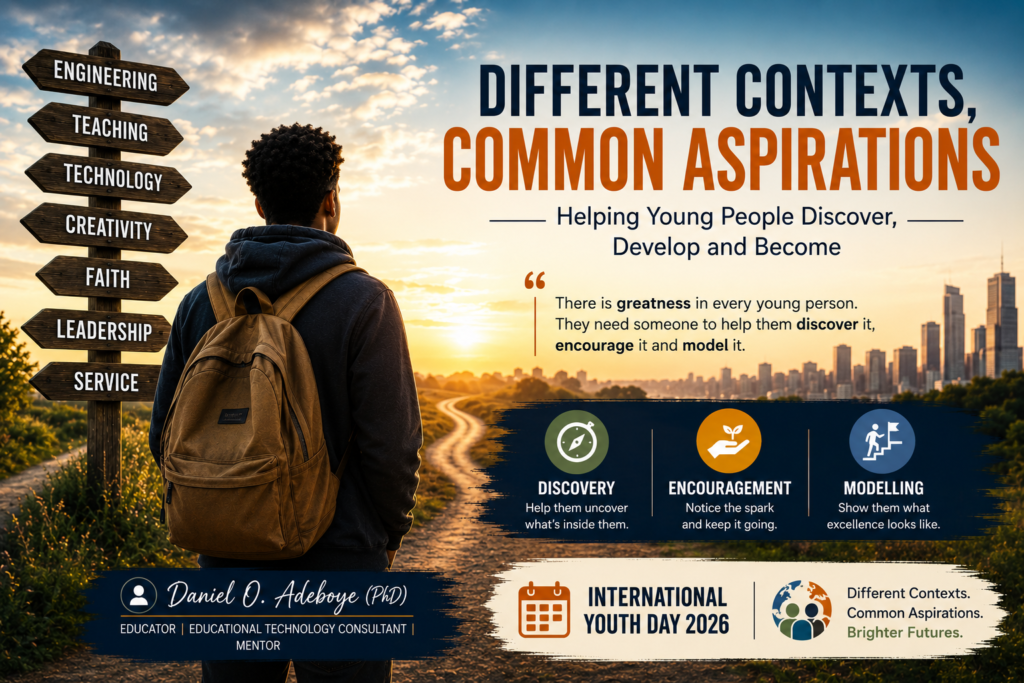
I believe there is greatness in many young people.
But greatness often needs sorting out.
It needs discovery.
It needs encouragement.
It needs modelling.
A young person may come from a completely different context from another. They may have different resources, different exposure and different challenges.
But they can still share a common aspiration: to become who they were created to become and to make a meaningful contribution with their lives.
I was once that young person.
Looking back, I am grateful that the adults around me did not insist that they understood everything I was trying to do before they encouraged me.
They helped me explore.
They encouraged me.
They corrected me.
They modelled things for me.
And gradually, the pieces began to come together.
So this International Youth Day, perhaps we should do more than celebrate young people.
Perhaps we should ask ourselves a more important question:
What gift am I helping them discover?
What little spark am I encouraging?
What standard am I modelling?
What opportunity am I creating?
What correction am I willing to give with love?
Because young people may come from different contexts, but their aspirations are often remarkably common.
They want to matter. They want to succeed.
They want to find fulfilment. They want to make a difference.
And perhaps our responsibility is not to write their entire story for them.
Perhaps it is to help them discover what God has placed inside them, give those gifts room to grow, and walk with them until they are ready to use those gifts to make their own contribution to the world.
Different contexts. Common aspirations.
And adults have a significant role to play in helping young people move from one to the other.
Happy International Youth Day, 2026!